When managing complex multi-entity groups, cross-border operations, and fragmented banking relationships, especially in Central and Eastern European markets such as Romania, Hungary, Poland, and Bulgaria, the limitations of spreadsheet-based liquidity management eventually force a choice: either the status quo operational risk or a legacy Treasury Management System (TMS).
For years, selecting an enterprise-grade TMS meant entering the orbit of legacy giants. While these platforms offer comprehensive functionality, their architecture was conceived in a different technological era, reliant on heavy host-to-host (H2H) integrations, complex SWIFT connectivity, and extensive customization layers.
Today, Open Banking technology has matured to an enterprise-ready state, introducing a new category of Treasury Management Automation Platforms. As corporate treasurers evaluate how to optimize financial workflows, they must look beyond marketing promises.
Before committing your organisation to a multi-year IT roadmap, we propose that you answer these 7 critical operational questions.
1. Treasury Management System Cost: What Is the True TCO?
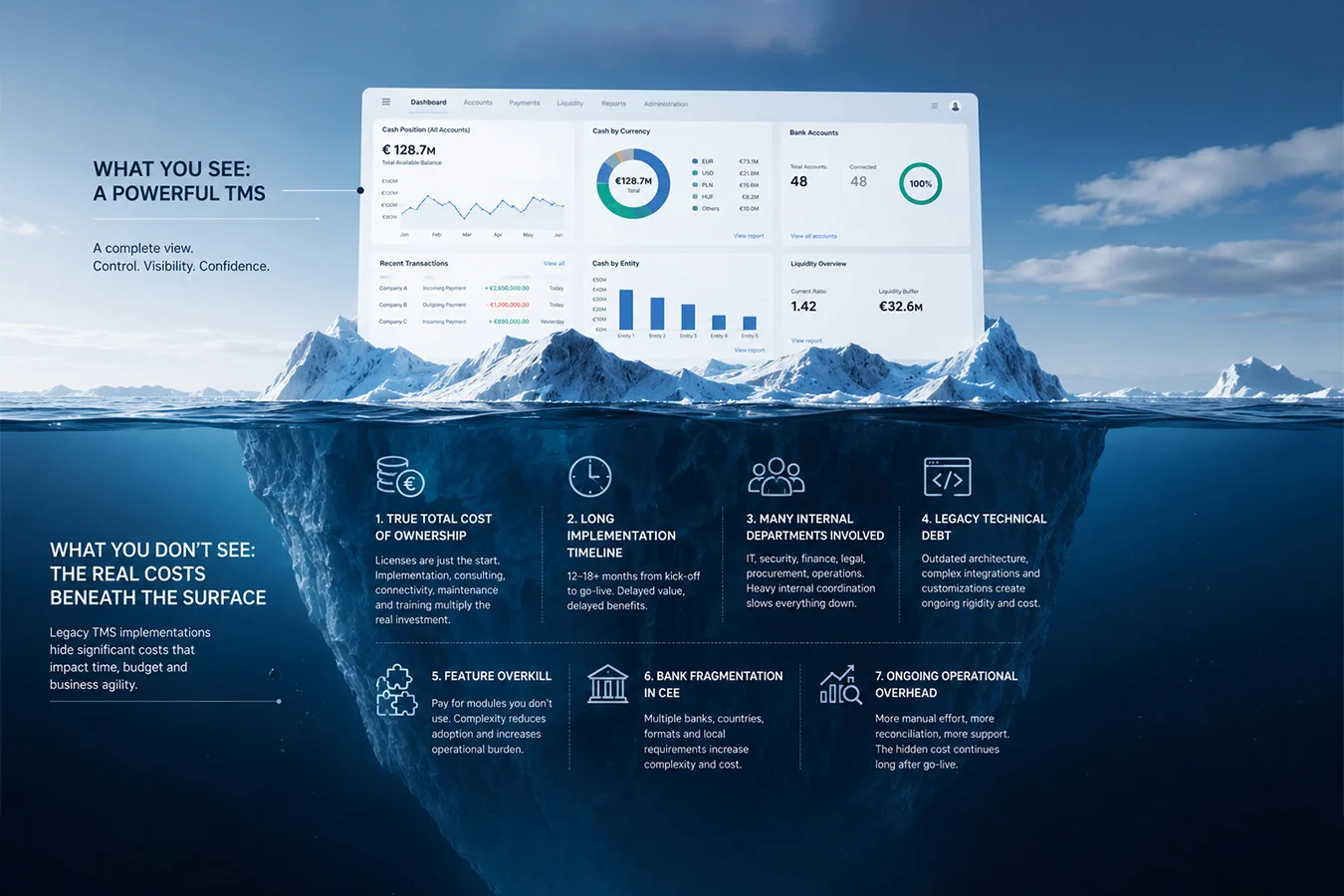
When evaluating a Treasury Management System, the software license or subscription fee is merely the visible top of the cost iceberg. Legacy providers operate on infrastructure that demands substantial hidden capital.
- Implementation Fees: It is very common for professional services and consultancy fees to double or triple the initial software quote.
- Connectivity Costs: Legacy systems rely heavily on SWIFT (MT940/MT101) messaging networks or custom Host-to-Host FTP connections. Every bank connection incurs setup fees, test environments, and ongoing message transmission costs.
- The Internal Resource Tax: The hidden cost includes the hours your internal finance, treasury, and accounting teams spend in endless discovery workshops, manual data-cleansing cycles, and user training.
API-native treasury management platforms fundamentally alter this economic equation. By leveraging secure, pre-integrated PSD2 Open Banking rails across the European Economic Area (EEA), bank connectivity costs are drastically reduced. Treasurers must calculate TCO not just in absolute euros spent, but in terms of resource diversion away from strategic capital allocation and financial risk management.
2. How long is the implementation timeline (and when will we see the first live cash position)?
The corporate treasury narrative is filled with cautionary tales of TMS implementations in which “discovery sessions” drag on for 6 months, and organisations find themselves, 12 to 18 months later, still adjusting system parameters without a single live bank feed in production.
Legacy architectures require a sequential, waterfall implementation methodology:
6-Month Discovery & Mapping ──> H2H / SWIFT Connection Setup ──> ERP Customization ──> Go-Live
In contrast, next-generation platforms like FinqTreasury decouple bank connectivity from downstream enterprise resource planning (ERP) integration. Utilizing real-time Open Banking aggregation, a corporation can complete compliance onboarding and connect live bank accounts across multiple CEE jurisdictions in days, not months.
Treasury teams can access a consolidated cash dashboard and manage multi-bank transactions while the IT team maps the automated reconciliation API into the ERP at their own pace. If a provider cannot promise live cash visibility within weeks of contract signing, their technology layer is unsuited for agile corporate operations.
3. Is the technology provider licensed, regulated, and PSD2 compliant?
In the consumer fintech landscape, software intermediaries frequently operate through unregulated screen scraping or loose third-party technical arrangements. For a corporate treasury department that manages high-value transactions, intercompany funding, and sensitive fiscal data, this approach poses significant regulatory and operational risks.
When a platform interacts with your banking infrastructure, security must be backed by an ironclad regulatory foundation. Treasury leaders must ask:
- Does the provider hold an official Payment Institution (PI) license issued by a national central bank?
- Are their services passported legally across all EEA target markets?
For instance, Finqware operates as a licensed Payment Institution authorized by the National Bank of Romania (BNR) and is explicitly passported across the EEA, holding official registrations with authorities such as the Magyar Nemzeti Bank (MNB) in Hungary, the Komisja Nadzoru Finansowego (KNF) in Poland, and the Bulgarian National Bank (BNB).
Furthermore, ensure the infrastructure has rigorous security credentials, such as ISO 27001 (Information Security Management) and ISO 22301 (Business Continuity), to ensure that the data lake and cloud-based normalisation layers meet enterprise governance criteria.
4. How many internal departments must be mobilized for deployment?
A classic symptom of a legacy TMS deployment is project creep across the corporate organizational chart. Because old-school systems require bespoke IT infrastructure, specialized security certificates, and custom communication protocols for every individual banking relationship, they cannot be deployed without heavy involvement from:
- Internal IT Infrastructure Teams
- Cybersecurity and Network Engineers
- ERP Specialists and External System Integrators
This creates significant friction. Corporate IT departments are frequently backlogged with core business projects, meaning a treasury transformation initiative can sit in queue for quarters before receiving technical allocation.
The litmus test for a modern treasury automation platform is whether it can be finance-led rather than IT-led. Because modern architectures manage underlying bank connectivity, API maintenance, and server maintenance on their own servers, the finance department can activate bank connections using standard corporate banking credentials.
Apart from the final step of wiring structured JSON data feeds into your ERP (such as Microsoft Business Central or SAP), the onboarding, dashboard setup, and multi-bank payment module require zero internal IT resource allocation.
5. Is the provider innovating at speed, or are they managing legacy technical debt?
The global payments infrastructure is undergoing its most profound shift in forty years. The mandatory migration to ISO 20022 XML schemas, the rapid adoption of real-time account-to-account (A2A) payments, the implementation of pan-European Instant Payment mandates, and the emergence of Request-to-Pay (R2P) architectures are reshaping working capital optimization.
Many legacy TMS providers are constrained by technical debt. Their core systems were engineered to process end-of-day (EOD) batches via MT940 files. To support real-time data, they must stack patchworks of middleware over aging codebases.
When choosing a partner, analyze their release velocity and technological baseline. An API-native platform doesn’t view real-time data as an optional add-on; it is the core standard. Treasurers should look for solutions that natively normalize disparate banking formats into a unified schema, ensuring that whether a transaction originates from a local CEE bank or a global Tier-1 institution, your systems receive clean, structured, reconciliation-ready data instantly.
6. Is the solution tailored to our operational realities, or is it functional overkill?
Enterprise software sales reps excel at showcasing advanced functionality: complex predictive AI forecasting, algorithmic cross-currency netting engines, and sophisticated derivative side-ledgers.
For a select group of global top-tier treasuries, these features are necessary. However, for regional mid-market corporate groups, large entrepreneurial businesses, and multi-entity organizations generating €10M to €500M+ in revenue, these features represent costly functional overkill.
Treasury leaders frequently buy a sledgehammer to crack a nut, paying for features they will never configure while their core operational pain points remain unaddressed:
The Core Reality: The daily operational drag in corporate finance isn’t a lack of derivative modeling—it’s delayed cash visibility, multiple manual portal logins, fragmented payment approval workflows, and labor-intensive spreadsheet-based bank reconciliation.
Platforms should be selected based on their efficacy in solving these concrete bottlenecks. As documented in enterprise deployments with market leaders like FAN Courier and One United Properties, the highest return on investment comes from establishing a clean, real-time corporate cash management control layer.
7. How does the system handle localized banking and cross-border fragmentation in CEE?
Mature Western European or North American corporate environments operate in highly consolidated banking markets. In Central and Eastern Europe, treasury teams face a highly fragmented ecosystem characterized by non-Euro currencies (RON, PLN, HUF, BGN), divergent local clearing houses, and distinct national electronic payment standards.
A generic global TMS vendor often struggles with the operational realities of CEE banking connectivity. They may have excellent pipelines into major Western institutions, but lack robust, deep-tier API coverage for local market players. This leaves regional treasurers with a fractured hybrid system: some accounts are automated, while localised regional accounts must still be checked manually via web tokens.
Your prospective provider must demonstrate proven native connectivity within the region. They must understand the nuances of local transaction formatting, multi-currency cash positioning, and the specific regulatory compliance requirements of local tax authorities.
The Strategic Takeaway
Choosing a Treasury Management System (TMS) is a strategic decision that impacts how your organization manages cash visibility, liquidity, payments, and financial operations for years to come. As corporate treasury teams modernize, the market is shifting from traditional, monolithic TMS platforms toward more flexible, API-driven treasury automation platforms that enable faster implementation, real-time bank connectivity, and better control across multiple entities.
Before committing to a long implementation roadmap, finance leaders should evaluate whether the chosen treasury management system truly matches their operational needs: implementation speed, total cost of ownership, bank connectivity, regulatory compliance, and the ability to support multi-bank and cross-border operations.
For organizations managing multiple banking relationships, fragmented account structures, and complex regional operations, the future of treasury management is not necessarily a heavier system with more complexity. It is a modern, Open Banking treasury platform that delivers real-time cash visibility, automated workflows, and scalable financial control without requiring a major infrastructure overhaul.
Gain instant visibility, automated reconciliation, and effortless payments — all in one secure platform, powered by Open Banking.