For CFOs, treasurers, and accountants operating across multiple entities, banks, and countries, fragmented banking setups are more than an inconvenience. They are an operational risk.
Delayed data, manual reconciliation, inconsistent payment flows, and limited visibility across accounts make it harder to forecast cash, close faster, and support business growth with confidence. In Central and Eastern Europe (CEE), these challenges have historically been amplified by uneven banking connectivity and limited access to reliable open banking infrastructure.
That reality changed in 2025.
Finqware’s expansion over the past 12 months is not just a company milestone. It signals growing operational maturity across finance teams in the CEE region and a clear shift toward finance automation as a strategic priority for corporate clients.
Over the last year, activity on Finqware’s core aggregation platform doubled. Platform usage increased across all key dimensions — API calls, completed consents, and payments — reflecting a deeper, more embedded role of open banking in daily finance operations.
This growth was not driven by experimentation or pilot use cases. It was driven by corporate finance teams relying on real-time bank connectivity and automated flows to run their operations.
- Monthly API calls increased from 10 million to 17.5 million — a 75% increase that exceeded internal projections and clearly indicated rising platform adoption and client activity.

- Completed consents more than doubled, growing from 2,500 to 5,200 per month. This increase reflects both improved consent flows and the technical stability required to support higher volumes of successful user journeys, with less friction and greater reliability.

- Monthly completed payments grew from 9,000 to over 20,000, representing a more than 120% increase. This growth signals a decisive shift toward automated, platform-based payment execution as finance teams place greater trust in the robustness and reliability of Finqware’s infrastructure.

Behind these numbers is a clear pattern: finance teams are moving away from manual processes toward centralized, automated banking connectivity they can trust.
At the core of this shift is Finqware’s Multibanking Automation Platform — designed to replace fragmented banking access with a single, reliable layer for finance operations. By connecting multiple banks, accounts, and payment flows into one platform, Finqware enables finance teams to centralize visibility, standardize processes, and scale treasury and payment operations without adding complexity.
In 2025, the number of businesses connected through Finqware’s open banking services grew more than fourfold, reaching close to 3,000 companies.

This growth spans two core segments:
- Corporate and holding customers, using FinqTreasury to consolidate accounts, manage cash across tens or hundreds of entities, and automate bank connectivity at scale.
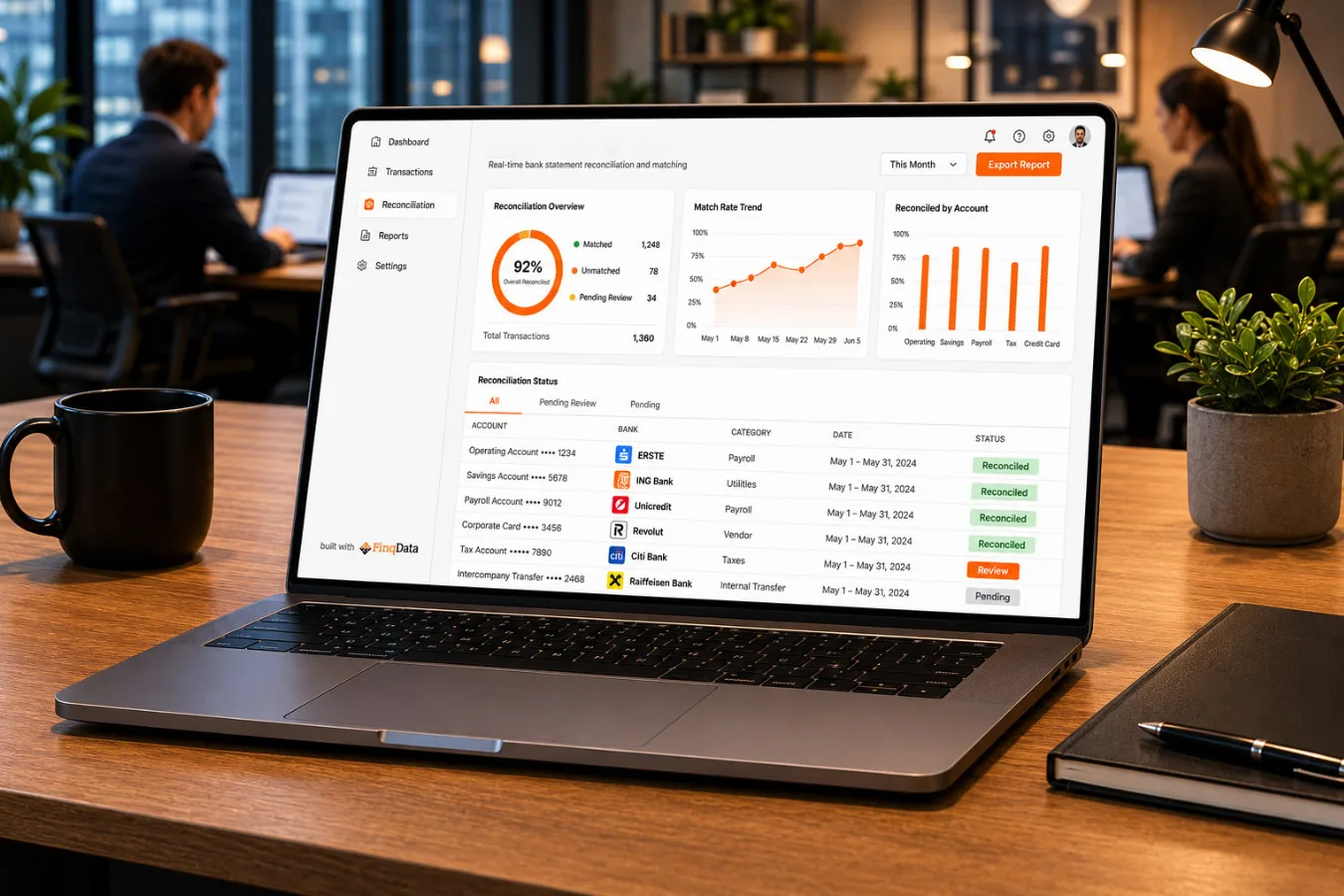
- SMBs using accounting and ERP platforms, where automated bank statement retrieval and reconciliation remove hours of manual work each month.
What matters most is not just the volume of connected companies, but the nature of their usage, which demonstrates long-term operational reliance. These are not one-off connections. They are ongoing, business-critical integrations supporting reporting, reconciliation, treasury management, and payments.
For CFOs overseeing multi-entity environments, this marks a clear shift: open banking is no longer a “nice to have” innovation. It has become foundational finance infrastructure.
In 2025, the value of payments processed through Finqware doubled compared to 2024 — increasing from a monthly average of €25M to €52M.

This growth was driven by two main flows:
- Bulk corporate payments initiated directly from ERPs and FinqTreasury, replacing manual bank uploads and reducing execution risk.
- App top-ups and invoice payments via FinqLink Pay, enabling instant A2A payments that are faster, safer, and more cost-efficient than traditional card-based alternatives.
For finance leaders, this matters because payment execution is where operational risk becomes real. Automating payments at scale — with visibility, control, and auditability — is a strong signal of process maturity.
Finqware’s strongest expansion in 2025 took place in Hungary, where FinqTreasury — the flagship product for corporate clients — now delivers:
- 95% banking connectivity coverage
- Over 1,000 connected accounts
- More than 45,000 daily transaction records
At the same time, bank connectivity expanded across Bulgaria, Poland, Czechia, Slovenia, and Slovakia, with the top seven banks connected in each market. This enables regional finance teams to operate on a unified banking layer rather than managing country-by-country exceptions.
For CFOs in mid-size international companies, this regional consistency is critical. It reduces reliance on local workarounds and enables standardization across entities, systems, and markets.
Growth in 2025 was also supported by new capabilities launched across the Finqware platform, each aligned with concrete finance use cases:
- Automated Bank Statements, powering accounting platforms such as Keez and Platformis, enabling continuous reconciliation and faster closes.
- Personal Budgeting & Planning, democratizing access to open banking data for consumer-facing financial tools like Money in Motion.
- Faster Invoice Payments, where FinqLink enables instant A2A payments that combine speed, security, and cost efficiency.
These capabilities reflect a consistent product direction: reducing manual intervention, increasing data reliability, and enabling finance teams to operate with confidence — not just speed.
As finance teams across Central and Eastern Europe scale their operations, the challenge is no longer access to banking data — but how effectively it is integrated into daily financial operations. The growth Finqware saw in 2025 reflects a broader shift toward finance operations that are automated, resilient, and built for multi-entity complexity.
For CFOs and Finance Directors navigating fragmented banking setups today, a centralized, multibanking automation approach can be the foundation for faster closes, real-time cash visibility, and more confident decision-making.